Boidier Hurst Scout campsite is owned jointly by Epsom and Ewell District and Leatherhead District Scout Councils.
The land known now as Boidier Hurst Scout Campsite was owned by Sir Oscar and Lady Warburg who lived at the
property called Boidier which is now named Magnolia Cottage and can be seen clearly on the Headley heath map 1977 extract
below.
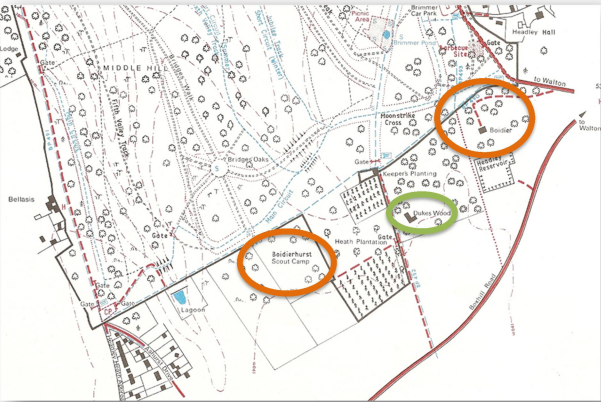
Sir Oscar and Lady Warburg acquired “Boidier” and considerable surrounding land in 1924. They had four sons one
of whom Robert (Bob) became involved in Scouting. Bob acted for 8 years as warden at Boidier Hurst and at some
time acted as Scoutmaster of the 3rd Epsom Group and later an Assistant District Commissioner.
On 8th October 1946 shortly after World War 2, Lady Catherine (Widdrington) Warburg donated 10 acres of
woodland to The Boy Scouts Association Trust Corporation for use by the then Epsom and Leatherhead Local
Association of the Boy Scouts Association for use as a scout camp site.
In February 1946 prior to the transfer, planning permission was gained for a change of use of the land to “a
permanent camping site for Boy Scouts”.
The origins of the name Boidier Hurst are not known however, the site clearly adopted the name of Sir Oscar and
Lady Warburg’s house with the addition of Hurst which may be a derivative of Hurt meaning wood . Lady Warburg
subsequently offered additional land at Heath Plantation to the Boy Scouts however it was decided at the time that
the Associations did not have the capacity to look after it so the kind offer was declined.
On 13th July 1952 a declaration of trust by the Boy Scouts Association was entered into changing responsibility for
Boider Hurst from Epsom and Leatherhead Local Association to Epsom Local Association, Ewell Association and
Leatherhead Association jointly, which were the new Scouting districts formed on April 1st 1952. This legal
undertaking established the requirement for an autonomous but joint management committee with members
selected from the three new associations. The document also transferred entire control of the property to the three
new bodies.
Bob Warburg and his wife bought 20 acres of land known as Heather Dukes plantation from their mother and built
Dukes Wood. This too is marked on the extract above. Orders for milk and Bread used to be taken at Dukes Wood
for visiting Scout troops however the property was “out of bounds” after 6.00PM to all campers as the children were
in bed! Following the death of Lady Warburg, the four sons transfered Headley Plantation to the National Trust.
In 1946 Boider Hurst was part of Betchworth Parish however this later became Dorking and Horley RDC and
ultimately Mole Valley District Council.
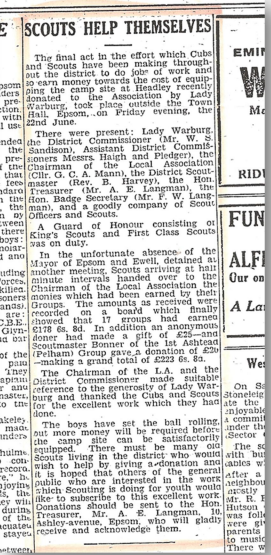
A newspaper cutting dated 29th June 1945 gave details of money earned by the cubs and Scouts to buy equipment for the site. The total raised was £178 6s 8d. As you can see from the extract, quite a fuss was made of the handing over ceremony at Epsom Town Hall.
In 1945 a potable water pipe was laid over ground to allow the site to be used for camping however, water board regulations required that this was placed underground. So in 1952 this was undertaken at a cost of £176. It took some time to backfill the trench by hand as the Farmer (Mr Marsh) had sown a crop in the field preventing access by machine. The original conveyance required a fence on two sides of the property to be maintained so it was proposed that each troop would be responsible for an equal portion and two prizes of a felling axe (these were provided by Mr BallandStubbs Chairman of leatherhead and District Association) were offered for the best effort.
In the beginning, the toilet arrangements consisted of “a rough wash bench and two chemical closets” however as the popularity of the site grew, a new toilet block was designed and built. Captain Morgan a nonuniformed member of 3rd Epsom, managed the project to create new facilities which were installed in 1965 at a cost of £775. The contract was undertaken by Site Work & Demolition Co (Epsom) Ltd. All the money had to be raised through grants and a shortfall of £175 was “bridged” by Captain Morgan until further funds could be raised. In 1965 the camping fee was 3d per person per night.
In 1972 a training building was given planning consent and built with the base being constructed using voluntary labour and Leofric Broadspan Buildings were employed to construct the building on the base. The whole project cost a total of £1735.
The storm in October 1987 did untold damage on site. Thankfully the buildings were not affected. The loss of so many mature trees actually helped shape the site of today as it allowed larger camping areas which in turn encouraged more light to encourage the grass to grow. In addition, a vast amount of timber was sold with the site benefitting from £457 from the sale of the timber. Records show 1,133.83 Hoppus feet of timber was sold at a price of £0.35 per Hoppus foot. (Hoppus Foot This volume measurement was developed to estimate the volume of a round log that would be usable timber after processing, in effect attempting to ‘square’ the log allowing for waste.)
In 1981 the first dedicated warden’s accommodation was built and as Roy Ballinger and Dennis Oakshot undertook much of the work, it was named Royden House.
In 1992 a kitchen extension was added to the training building at a cost of £4,207. On completion, the training building was named the Manly Building in 1995 as a tribute to Alf Manly who contributed so much time towards managing the construction project.
In 1994 parts of the old Spring Mixed Unit building in Ewell were demolished from behind the 2nd Ewell headquarters and were transported to Boidier Hurst to be used to construct the openfronted transit shelter. Boidier Hurst committee held a 50 year celebration on 21st June 1997. It was attended by Eric Warburg (Lady Warburg’s nephew) and his wife Netty. The toilet block was extended in 1995 adding in Leader’s toilets and extended again in 2005 adding Female campers toilets, showers and outside washingup facilities. The “old faithful” septic tank was also made redundant with the installation of a new 17,000 litre tank located at the end of the “fire break”. Planning at the time was also achieved for a bunkhouse however it was decided that this element of the project should be shelved owing to lack of available funds. Who knows it might be built one day and added into this potted history! Boidier Hurst remains to this day a marvellous asset for Epsom and Ewell District and Leatherhead District Scouts. It was a wonderful gift that Lady Warburg made to Scouting that has seen many volunteers over the years passing on custodial care to protect and enhance the camp site. It has allowed many thousands of young people for over 60 years to learn Scouting skills and experience the joy of “real” camping in a most wonderful environment.